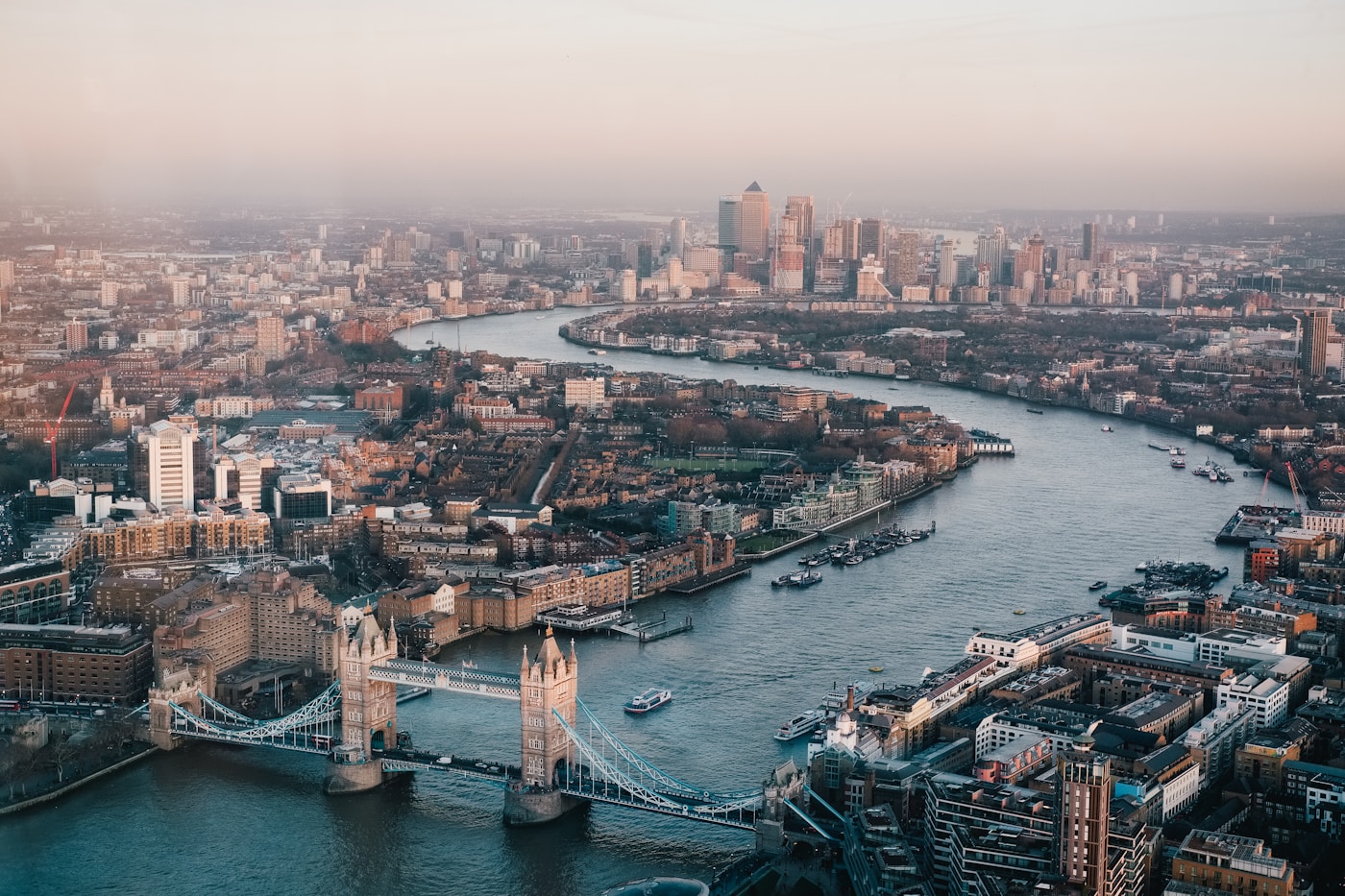
London is not a city you can memorise. There is no grid, no ring road that simplifies it into a shape you can hold in your head. It is a sprawl of villages absorbed over centuries, each with its own high street and its own pub. That is what makes it a good subject for a map poster.
Some cities were planned on a drawing board. Washington DC has radiating avenues. Chicago has a rigid township grid. Barcelona has chamfered blocks. London grew organically. The City of London, the original square mile, was established by the Romans in 43 AD. The street pattern there has barely changed in 2,000 years. Stand at the Bank Junction and you are on the same spot where Roman merchants traded. The streets still follow the lines of the original settlement.
The River Thames is the spine of the city. Everything bends around it. The Strand follows the old river road. The Borough runs south across London Bridge. The river is not a boundary. That is why a London poster reads so clearly. The dark curve of the Thames cuts through the centre and separates the dense north from the greener, more open south.
Then there are the parks. Hyde Park, Regent's Park, Hampstead Heath, Greenwich Park. They appear on the map as large, irregular green spaces that break up the street pattern. On a Noir print, they are white voids in the black street network. On Foliage, they are amber patches in the autumn-toned grid.
What the poster captures that a photograph cannot is the texture of London. The streets cluster around old village centres like Clapham and Richmond. The railways cut through neighbourhoods and create boundaries that still define where people live. The river meanders through it all, indifferent to the human grid above it.
The best London poster is not the one that shows you where everything is. It is the one that shows you how the city feels. Dense, layered, and never quite finished.
Browse London map posters